Digital License Plates 101: What Fleet Managers Need to Know

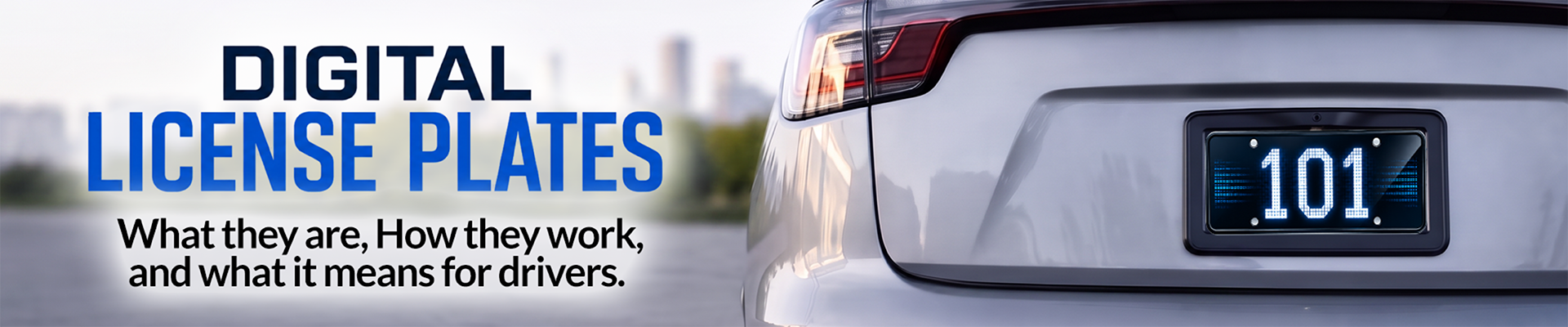
For most of a century, a license plate has been a stamped piece of metal with one job: identify the vehicle. That's starting to change. Digital license plates — thin, connected screens that replace the traditional metal plate — are now legal in a handful of states, and at least one manufacturer has built a version specifically for commercial fleets. Whether that matters for your operation depends on where you run vehicles and what problem you're trying to solve.
What a digital plate replaces
A digital plate looks close to a standard plate at a glance, but the surface is a durable LCD or e-ink display rather than embossed metal. Reviver, the main player in this space, sells a consumer version (RPlate) and a fleet-oriented version (RFleet). Both connect over LTE or Bluetooth and pair with an app or fleet management portal.
The core function stays the same as a metal plate: display the registration number so the vehicle is identifiable. The added layer is that the display and its connectivity open up a few capabilities a stamped plate can't offer — remote registration renewal, custom banner messages, theft or recovery alerts, and, on the commercial side, location and status tracking tied to the plate itself rather than a separate device.
Where this stands legally
Availability is narrow. As of this writing in august 2026, digital plates are approved for registration in California, Arizona, and Michigan, with Texas approving them for commercial vehicles specifically. They're legal to drive across state lines once registered, but you can't currently register a new one outside those states.
Why a fleet manager might look at this
A few use cases come up often enough to be worth naming directly:
- Registration renewal without a physical decal. For a fleet spread across a wide territory, mailing decals or routing vehicles through a DMV visit adds friction that a remote renewal removes.
- Location and recovery data tied to the plate. RFleet markets vehicle location tracking as part of the plate itself, which could reduce reliance on a separate hardware installation for that specific function.
- Fleet identification and messaging. Custom banners can display a company name or a status message, which has some appeal for branded service vehicles.
None of these are dramatic enough to justify a rip-and-replace of an existing telematics setup on their own. They're incremental conveniences that happen to be bundled into the plate.
Questions worth asking before adopting
Before treating this as anything beyond a states-you-operate-in check, a few practical questions are worth working through with your fleet management company and your own operations team:
- Does this duplicate what your telematics already does? Most fleets already have GPS and vehicle status data flowing through an existing telematics platform. A digital plate's location tracking may be redundant, and running two systems that both claim to own vehicle location data can create more reconciliation work than it saves.
- Who owns the data, and where does it go? Digital plates that track location and trip data raise the same questions any connected device does. Ask what's collected, how long it's retained, and whether it's shared with third parties, including law enforcement, absent a warrant or legal request.
- What's the real cost per vehicle? Beyond the hardware price, most digital plate programs run on a subscription plan. For a fleet of any size, that recurring cost needs to be weighed against what it's replacing — a stack of metal plates and decals — against a broader feature set that overlaps with tools already in your telematics stack.
- How does this interact with upfitting or resale? Anything mounted to a vehicle's exterior with connectivity requirements is worth flagging to whoever handles upfitting and end-of-lease turn-in, so it doesn't become a surprise line item or a compliance question at resale.
Where this is headed
Digital plates are a new category, but adoption is still early and geographically limited. For most fleet managers, the near-term move is awareness rather than action: know that the option exists, understand what it does and doesn't add over your current telematics stack, and revisit the decision if your operating states expand approval. If you're running vehicles in California, Arizona, Michigan, or Texas today, it's worth a closer look at whether the specific features on offer solve a problem your fleet has right now.
EMKAY helps fleet managers evaluate new vehicle technology against what their existing programs already deliver, from telematics integration to lease structuring. If you're weighing a change to your fleet's technology stack, get in touch to talk through the options.
Dash Cam Compliance Rules Are Coming for Fleets
A new regulation out of British Columbia is putting a hard deadline on dash cam requirements for commercial vehicles: by November 28, 2026, qualifying trucks operating in or passing through the province must carry a compliant camera system, with defined standards for video resolution, footage retention, and night visibility. As written, the mandate targets heavy-duty units over 26,000 lbs, so most light-duty and service fleets won't fall under it directly.
Best Compact Cargo Vans for Commercial Fleets: What's Available in 2026
If you've been searching for a "best compact cargo van" comparison, here's the complication: for most of 2026, there hasn't been a real list to make. Nissan, Ford, Ram, and Mercedes-Benz all pulled their small commercial vans from the U.S. market between 2021 and 2023, and fleets that once ran Transit Connects or NV200s have spent years piecing together alternatives instead.