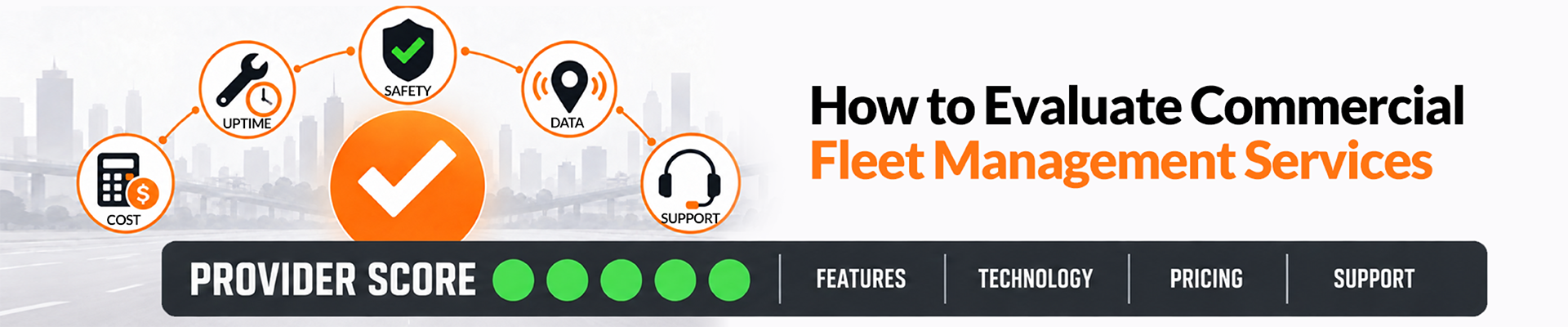
How to Evaluate Commercial Fleet Management Services

Try to research commercial fleet management and you'll get a wall of vendor homepages and a handful of "best fleet management software" roundups that all rank the same five providers in a different order. None of it tells you what your operation needs to check before signing a contract.
This guide skips the rankings and gives you a framework instead: the service categories that make up modern fleet management services, the questions to ask a provider, and the red flags that can show up later. It's written for leaders overseeing light-duty and service vehicles — sedans, SUVs, vans, and work trucks — not long-haul freight operations, which run on a different set of metrics entirely.
Why "Top 10" Lists Miss the Point
A search for top 10 fleet management companies returns exactly what you'd expect: listicles built from affiliate partnerships, SEO placement, or a vendor's own marketing budget. Rankings like these compress a decision that should hinge on your fleet's size, vehicle mix, and internal capacity into a single ordered list, as if every fleet has the same requirements.
A 40-vehicle regional service fleet and a 400-vehicle national sales fleet need different things from a provider. A company with an in-house maintenance shop needs a different scope of work than one outsourcing everything. Ranking providers by popularity or marketing spend skips past the variables that determine fit. A better starting question isn't "who's ranked highest" — it's "which of these five service categories do I need help with, and how do I evaluate a provider in each one?"
The Core Categories of Commercial Fleet Management
Commercial fleet management, at its broadest, is the coordination of everything required to keep a fleet of vehicles operating: acquisition, maintenance, compliance, tracking, and eventual disposal. Providers package these pieces differently, so the first evaluation step is figuring out which categories you're buying.
1. Fleet Maintenance Services
Fleet maintenance services cover preventive maintenance scheduling, repair coordination, warranty tracking, and vendor network management. This is often the category with the clearest ROI, since deferred maintenance shows up quickly in downtime and repair costs.
When evaluating a provider's maintenance program, ask:
- How large is the certified repair network, and does it cover the geographic footprint of your fleet?
- Does the provider negotiate rates directly with shops?
- What's the average turnaround time for a routine service visit versus an unscheduled repair?
- Can you see maintenance history and upcoming service needs per vehicle without submitting a request?
2. Fleet Tracking Systems
Fleet tracking systems — GPS telematics, driver behavior monitoring, and route data — have moved from a nice-to-have to table stakes for most fleets over the past several years. The evaluation question here isn't whether a provider offers tracking; nearly all of them do. It's whether the tracking data connects to anything actionable.
Look for:
- Integration between tracking data and maintenance alerts (idle time and hard-braking events tied to service intervals, not just a map view)
- Driver scorecards operations managers can use directly for coaching conversations
- Data ownership and export terms — some providers make it difficult to take your telematics history with you if you switch
Telematics vendors that only sell hardware and a dashboard, with no maintenance or compliance layer on top, are a different product category than full-service fleet management. Neither is wrong, but conflating the two during evaluation leads to mismatched expectations later.
3. Fleet Management Software
Every provider in this space runs on some form of fleet management software, whether proprietary or licensed from a third party. The distinction that matters for evaluation is how much of that software is exposed to you versus operated as a black box on the provider's side.
Questions worth asking:
- Does the platform give fleet managers direct visibility into costs, utilization, and maintenance status?
- How configurable is the reporting? Can you build views specific to your cost centers, regions, or vehicle classes?
- What happens to your data and configuration if you switch providers — is there a defined export process, or does the relationship end with a data request ticket?
Software quality is easy to judge in a sales demo and hard to judge in daily use. Ask for references from customers who've been on the platform for at least a year.
4. Vehicle Acquisition and Lease Structure
Fleet providers typically offer some combination of open-end leases, closed-end leases, and fleet purchasing programs. This piece determines cash flow, residual value risk, and how easily you can adjust fleet size as business needs change. It's worth its own evaluation conversation, since lease structure has more long-term financial impact than any software feature.
Open-end leases shift residual value risk to the fleet operator but generally come with lower monthly payments and more flexibility to hold a vehicle past a fixed term. Closed-end leases fix the residual value up front, trading some flexibility for cost predictability. Fleet purchasing programs remove the leasing relationship entirely, which suits operators with the capital and internal expertise to manage remarketing and disposal on their own.
5. Compliance and Safety Administration
DOT compliance (where applicable to your vehicle classes), driver qualification files, and safety policy administration round out the service list. A provider handling this well reduces administrative burden on internal staff; one handling it poorly creates liability exposure that surfaces at the worst possible moment — usually after an incident.
For light-duty and service fleets, this category often gets underweighted during evaluation because the regulatory burden looks lighter than it does for freight operations. Registration renewals, accident reporting workflows, and driver license monitoring still need a clear owner. Ask who is responsible when a driver's license status changes mid-lease, and how quickly that information reaches your safety team. A provider without a documented answer is one you'll be chasing down after something has already gone wrong.
Total Cost of Ownership, Not Just the Monthly Invoice
A quoted monthly rate is the easiest number to compare across providers and the least useful one on its own. Total cost of ownership includes fuel, maintenance, downtime, administrative labor, and the residual value realized at disposal. Two providers quoting similar monthly rates can produce very different total costs once maintenance markups, out-of-network repair fees, and end-of-lease charges are factored in.
Request a sample total-cost breakdown for a vehicle class comparable to yours, not just a base monthly rate. Providers confident in their pricing structure will walk through this without hesitation.
Building an Evaluation Framework
Once you know which categories you're sourcing, score prospective providers against the same criteria set for each one:
- Scope clarity. Get a written breakdown of exactly what's included versus billed separately. Vague language around maintenance coverage or telematics data access tends to become expensive later.
- Data access. Fleet managers should have real-time visibility into vehicle status, cost, and compliance data — not a monthly summary delivered on the provider's schedule.
- Network coverage. For maintenance and repair, coverage needs to match your fleet's actual geography, not the provider's national footprint on paper.
- Contract flexibility. Fleet size changes. Confirm how easily you can add, remove, or reassign vehicles without renegotiating the entire agreement.
Run every finalist through this same list side by side. It won't produce a ranked "top 10," but it will produce a clear picture of which provider fits your operation.
Vehicle Fleet Solutions Aren't One-Size-Fits-All
The phrase vehicle fleet solutions gets used as a catch-all for everything from a single telematics subscription to a fully outsourced fleet department, and that ambiguity is exactly why a structured evaluation needs more than a vendor comparison chart. The right fit depends on how much of the work you want to keep in-house versus hand off, how large and geographically distributed your fleet is, and how much visibility your team needs into day-to-day operations.
A fleet manager overseeing 30 service vans in one metro area has different priorities than one managing 3,000 vehicles across a dozen states. Both might land on a provider offering similar core services, but the evaluation questions — network coverage, reporting granularity, contract flexibility — carry different weight for each.
Structuring the Evaluation Process
A structured request-for-proposal process makes side-by-side comparison possible; an round of sales calls does not. A few steps that keep the process grounded in your fleet's actual requirements:
- Document your current-state baseline first. Before requesting proposals, pull your existing costs by category — maintenance, fuel, telematics, administrative labor — so you have a real comparison point rather than taking a provider's projected savings at face value.
- Send identical scope requests to every finalist. Ask each provider to quote the same vehicle mix, the same service categories, and the same reporting requirements. Variation in what's included makes price comparison meaningless.
- Score categories separately before scoring providers overall. A provider can offer strong maintenance coverage and weak telematics reporting, or vice versa. Rolling everything into a single overall score early in the process hides those trade-offs.
- Involve the people who'll use the system daily. Procurement teams evaluate contracts; operations managers and dispatchers evaluate whether the dashboard and reporting tools are usable during a normal workday. Include both perspectives before finalizing a decision.
Red Flags Worth Watching For
A few patterns show up repeatedly with fleets that switch providers within the first contract term:
- Sales conversations that emphasize software features but go vague on maintenance network size or repair turnaround
- Reporting that arrives as static documents rather than a live dashboard
- Reluctance to provide references with a comparable fleet size and vehicle mix
- Contract terms that penalize fleet size changes rather than accommodating them
None of these are disqualifying on their own, but two or more in the same evaluation is worth a closer look before signing.
Talk to a Provider Directly
Rankings and comparison charts can narrow a list, but the details that determine whether a partnership works — network coverage in your specific service area, how reporting is structured, how contract terms handle fleet size changes — only surface in a direct conversation with a provider's team.
EMKAY works with fleet managers overseeing light-duty and service fleets to build maintenance, tracking, and lifecycle programs around the specifics of their operation. Reach out at 630.250.7400 or info@emkay.com to talk through what your fleet needs.
5 Things to Look for in a Fleet Accident Management Provider
An accident involving a company vehicle sets off a chain of decisions that must happen fast: first notice of loss, driver safety checks, repair authorization, rental coordination, and eventually a claims settlement. How well a fleet accident management provider handles that chain determines whether a single incident costs a few days of downtime or turns into a multi-week disruption. Evaluating providers on the right criteria upfront saves fleet managers from discovering the gaps mid-claim.
7 Best Fleet Vehicles for Salespeople in 2027
A field sales rep judges a car differently than a commuter does. Cargo room matters more, seat comfort is a priority if clients may be in the car and miles add up fast. For fleet managers building out a 2027 sales fleet, these seven vehicles are worth a close look against those criteria.