5 Things to Look for in a Fleet Accident Management Provider

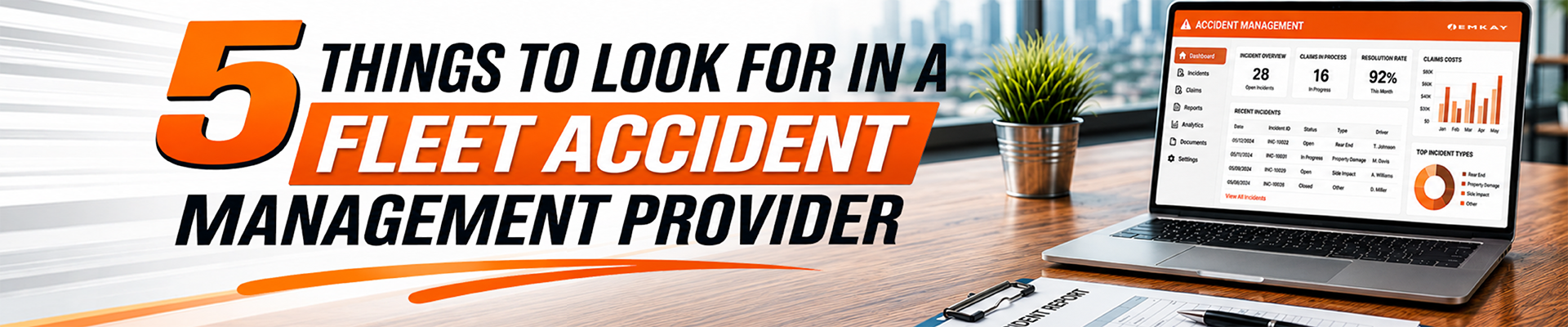
An accident involving a company vehicle sets off a chain of decisions that must happen fast: first notice of loss, driver safety checks, repair authorization, rental coordination, and eventually a claims settlement. How well a fleet accident management provider handles that chain determines whether a single incident costs a few days of downtime or turns into a multi-week disruption. Evaluating providers on the right criteria upfront saves fleet managers from discovering the gaps mid-claim.
Here are five things worth checking before signing with a provider.
1. Speed and simplicity of first notice of loss (FNOL)
The clock starts the moment an incident happens. A provider's FNOL process should let drivers report an accident in minutes, whether that's a phone call, a mobile app, or a web form, and it should route that information to a claims adjuster immediately rather than sitting in a queue.
Ask providers how quickly a claim is assigned to a handler after intake, and whether drivers get real-time confirmation that the report went through. A slow or confusing FNOL process delays every downstream step, from repair authorization to rental car dispatch.
2. Repair network coverage and quality control
Providers typically work with a network of pre-vetted repair shops, and the strength of that network varies widely. Look for a national footprint that covers the regions your fleet operates in, not just major metro areas. Ask about the vetting criteria for shops in the network: certifications, average cycle time, and whether the provider audits repair quality after the fact. A provider with a thin or uneven network can end up sending vehicles to shops with long backlogs, which drags out downtime regardless of how fast the claim itself was processed.
3. Subrogation and recovery management
When another party is at fault, recovering repair costs and related expenses from their insurer is its own workflow, and it's one fleets sometimes handle poorly on their own. A strong provider pursues subrogation actively, tracks recovery rates, and reports on how much was recovered versus what was pursued. Ask for historical recovery rate data and how the provider handles disputed liability. This is an area where the financial upside of a good provider becomes concrete and measurable.
4. Rental and downtime coordination
A vehicle out of service is a driver who can't do their job, so rental coordination matters as much as the repair itself. Check whether the provider arranges rental vehicles directly as part of the claim workflow, what class of vehicle they default to, and how they handle situations where a specialized or upfitted vehicle is out of commission. Some providers also track total days of vehicle downtime per incident, which is a useful metric for measuring their own performance over time.
5. Reporting, data access, and program transparency
Fleet managers need visibility into claim status, cost trends, and driver-level incident history to run a program well, not just after an incident but on an ongoing basis. Ask what reporting the provider offers: real-time claim dashboards, monthly summaries, year-over-year trend data, or driver risk scoring tied to accident frequency.
Providers that treat this data as a black box make it harder to spot patterns, whether that's a specific route, vehicle type, or driver group generating disproportionate claims. Transparent reporting turns accident management from a reactive function into an input for broader safety and risk decisions.
Weighing these criteria together
No single factor above tells the whole story. A provider with a fast FNOL process but a weak repair network still leaves vehicles sitting for weeks. One with strong subrogation recovery but poor reporting makes it hard to see whether the program is actually working. The providers worth shortlisting perform well across all five areas, and asking pointed questions about each during the evaluation process, rather than relying on a sales pitch, is the best way to find out where they actually stand.
Accident management is one piece of a larger fleet risk picture that also includes driver safety programs, maintenance scheduling, and vehicle replacement cycles. Fleet managers evaluating providers should treat it as part of that broader ecosystem rather than a standalone purchase.
EMKAY's fleet management programs include integrated accident management support designed to reduce downtime and simplify claims handling for light-duty and service fleets. Learn more about EMKAY's accident management services.
Best Compact Cargo Vans for Commercial Fleets: What's Available in 2026
If you've been searching for a "best compact cargo van" comparison, here's the complication: for most of 2026, there hasn't been a real list to make. Nissan, Ford, Ram, and Mercedes-Benz all pulled their small commercial vans from the U.S. market between 2021 and 2023, and fleets that once ran Transit Connects or NV200s have spent years piecing together alternatives instead.
How to Evaluate Commercial Fleet Management Services
Try to research commercial fleet management and you'll get a wall of vendor homepages and a handful of "best fleet management software" roundups that all rank the same five providers in a different order. None of it tells you what your operation needs to check before signing a contract.