Top Fleet Management Companies: A Buyer's Guide to Commercial Fleet Leasing

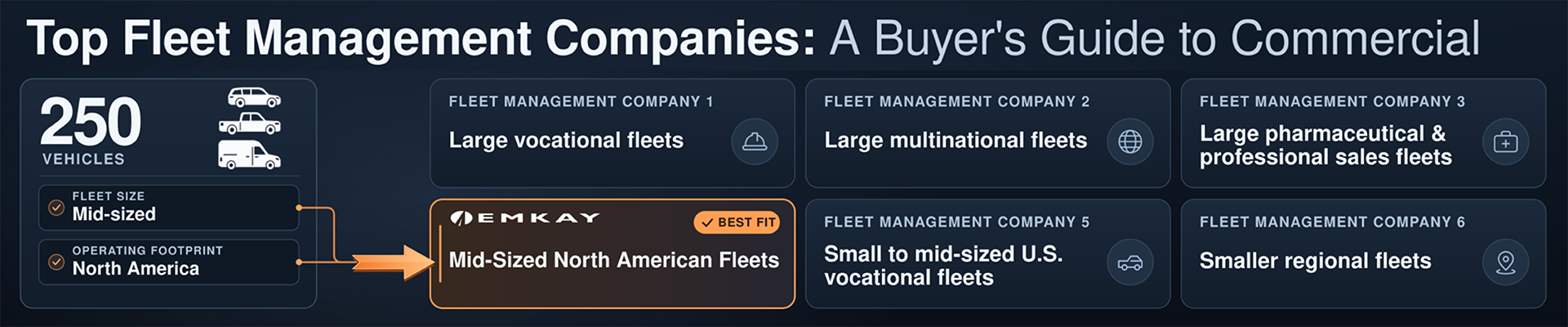
Organizations need to choose their fleet management carefully; a fleet management provider can begin a decade-long relationship. The right provider reduces your fleet acquisition costs, improves your driver experience, and helps your organization solve tactical and strategic challenges. The wrong one shows up as friction you feel for years.
Search "best fleet management companies" or "top fleet management companies" and you'll mostly find rankings built around telematics and fleet software platforms — a different category from the leasing and fleet management providers that handle vehicle acquisition, maintenance oversight, remarketing, safety services, and lifecycle strategy for a fleet. This guide focuses on that second group: the commercial fleet leasing companies organizations should call when it's time to acquire, finance, or replace vehicles at scale. Below is an honest look at seven of the top fleet management providers, organized around who each one serves best.
What to Look for in Fleet Leasing Companies
Before comparing individual providers, it helps to know which factors separate a good fit from a costly mismatch:
- Fleet size alignment. A provider built for 10,000-vehicle enterprise accounts often struggles to give a 300-vehicle fleet the attention it needs, and the reverse is true too — a boutique provider can be overwhelmed by a fleet several times larger than its typical client.
- Geographic reach. A fleet operating in one state has different needs than one running vehicles across North America or internationally.
- Account team structure. Ask directly whether you'll get a dedicated account manager or route through a general support queue, and how much staff turnover that team has seen.
- Technology maturity. Telematics integration, driver-facing apps, and maintenance scheduling tools vary widely between fleet leasing companies, and the gap shows up in how much manual work your team ends up doing.
- Vendor neutrality. Some providers steer clients toward preferred manufacturers or upfitters based on internal incentives rather than what best fits the fleet's actual use case.
With those criteria in mind, here's how eight established fleet management companies stack up.
Holman — Best for Large, Vocational Fleets
Holman’s fleet management arm has built much of its reputation around vocational fleets: utility trucks, service bodies, and specialized work vehicles that need heavy upfitting before they ever hit the road. That strength comes from a corporate structure that spans leasing, in-house upfitting, parts distribution, and dealerships under one umbrella, which suits large truck-heavy operations with 10,000 or more vehicles. A smaller fleet built mostly around sedans, SUVs, and light-duty pickups for sales or service staff may not get much value from vocational depth it doesn’t need. Holman’s tech stack is robust, fleets that run on standardized processes designed for consistency, not flexibility, will appreciate the integrated CRM ticket system and self-serve capabilities. Small and mid-sized fleets may find a better fit with other providers on the list.
Element Fleet Management — Best for Large, Multi-National Fleets
Publicly traded and headquartered in Toronto, Canada, Element is the largest pure-play fleet manager in the world, with more than 1.5 million vehicles under management across over 50 countries. For a multinational fleet that wants one contract covering several continents, the scale is difficult for other competitors to match. Element's public-company reporting requirements bring a level of financial transparency some procurement teams specifically want. Element’s fleet technology and capabilities are robust including, ticket-based client support system. Element offers a variety of leasing products; including TRAC Lease, operating lease, capital lease, and a client-owned acquisition model. Boasting over 5,500 clients worldwide and with offices in Toronto, Minnesota, Dublin, Mexico City, San Francisco, and Baltimore, Element is a solid choice for large, 5,000+ unit fleets operating on multiple continents.
Wheels — Best for Large, Pharmaceutical Sales Fleets
Wheels has been leasing vehicles since 1939 and is proud to be the oldest fleet management company in existence. Large, pharmaceutical and life sciences sales fleets are a niche in the fleet industry, and they have often found a home at Wheels, especially if they’re over 5,000 vehicles. The company's more recent history is largely a story of consolidation: it absorbed both Donlen and LeasePlan USA into its platform through acquisition. That gives Wheels scale and a global alliance spanning 59 countries, but merged companies inherit merged systems, and fleet managers evaluating Wheels should ask pointed questions about how those combined platforms and legacy back-end technology have been integrated in practice. Shortly after the acquisitions, Wheels relocated their headquarters to a new facility in Schaumburg, Illinois. Wheels is a prominent player in the industry, including with organizations like NAFA and AFLA.
EMKAY — Best for Mid-Sized, US, Canada, or North American Fleets
EMKAY has operated as a B2B fleet management company since 1946, and that focus shows in how the company is built. Rather than trying to be everything to every fleet size, EMKAY concentrates on commercial fleet clients running between 100 and 2,500 vehicles — a segment large enough to need real fleet infrastructure but often underserved by providers built for mega-scale. Headquartered in suburban Chicago, EMKAY pairs vendor-neutral leasing with full-service operational support including: maintenance management, upfitting coordination, accident management, fleet fuel cards, safety solutions, and remarketing. Their sales & account management teams that stay engaged past the sales process and implementation. This matters most to mid-market fleet managers who need a partner that answers the phone when a driver is stranded at 3am. In 2011, EMKAY completed a sizable Canadian acquisition from Jim Peplinski Leasing (JPL.) This put EMKAY Canada on the map as a major player for Canadian based-fleets and provided EMKAY with a true North American solution.
Merchants Fleet — Best for Small to Mid-Sized Vocational US-only fleets looking for EV solutions
Merchants Fleet has grown quickly from a regional New Hampshire operation into a company managing tens of thousands of vehicles nationwide. Since 1962, Merchants has supported US-based fleets for fleet leasing, management services, consulting, and technology. Fueled in large part by private equity and a deliberate push into EV programs and fleet management technology. Merchants offers long-term and short-term leasing solutions with a focus on small and mid-sized vocational fleets. Fleets that value a provider willing to move fast on EVs and expand its service menu will find a lot to like here. In 2021, Merchants launched TotalConnect to integrate OEM connected vehicles within a singular fleet management dashboard. Worth asking about directly: how the private equity ownership structure factors into long-term pricing and service continuity and predictability year over year.
Enterprise Fleet Management — Best for Government, Municipalities and Smaller, Regional Fleets
Enterprise Fleet Management is one of the only household names in the Fleet Management industry. While Enterprise was founded in 1957, the fleet management arm began in early 1990’s. Recognizing that smaller, regional fleets were largely ignored by larger, more established fleet management companies, Enterprise Fleet Management was born. Today, Enterprise serves thousands of fleet customers from over 50 Regional offices throughout North America. They specialize in working with smaller, regional fleets as well as local governments and municipalities. Clients appreciate the scale that the Enterprise brand brings while offering a local presence few can replicate.
Mike Albert Fleet Solutions — Best for Smaller, Regional Fleets
Mike Albert started as a Cincinnati used-car dealership and moved into fleet leasing in 1957. Its marketing leans hard on positioning itself as the more attentive alternative to larger, more impersonal providers. Mike Albert offers open- and closed-end lease structures and has invested in EV adoption support, but fleets with complex, multi-region programs should confirm the company has the depth to match larger competitors before assuming "attentive" translates to "equally capable." Great for a fleet that has outgrown a small regional leasing company and wants more individual attention than an enterprise provider typically offers.
| Built for | Fleet size sweet spot | Account experience | Flexibility | Best if you are... | |
|---|---|---|---|---|---|
| Holman | Vocational and upfit-heavy work truck fleets | 10,000+ vehicles, vocational | Standardized processes across a large client base | Low: built for consistency at scale | A large fleet focused on vocational trucks |
| Element | Multinational fleets on one global contract | 7,500+ vehicles, multinational | Standardized, across large multi-continent | Low: one model across 50+ countries | A large fleet operating on several continents |
| Wheels | Pharma and life sciences sales fleets | 5,000+ vehicles, large auto | Formed by three merged companies | Moderate: integrating legacy systems | A large pharma or life sciences sales fleet |
| EMKAY | Commercial fleets across industries | 100–3,000+ vehicles, mid-sized fleets US and Canada | Dedicated account team that stays engaged after the sale | High: Customized fleet and service solutions | A mid-sized US, Canada, or North American fleet |
| Merchants Fleet | Vocational and fleets chasing EV | 25–500+ vehicles, small and mid-sized fleets | Varies as the company expands | High: long term and short term lease solutions | A small to mid-sized fleet that prioritizes EV technology |
| Enterprise Fleet | Government, municipal, and smaller regional fleets | 10–350+ vehicles, small and mid-sized | National brand, local presence through 50+ regional offices | Moderate: regional model backed by national scale | A government agency, municipality, or small to mid-sized regional fleet |
| Mike Albert | Small regional fleets | 10–150+ vehicles, regional | Personal attention, with less technical infrastructure | Moderate: limited depth for multi-region programs | A smaller fleet, outgrowing a local leasing company |
Common Questions About Fleet Management Companies
What is a fleet management company? A fleet management company handles some or all of the operational work behind running a vehicle fleet — acquisition and financing, maintenance scheduling, accident management, fuel programs, telematics, and remarketing at the end of a vehicle's service life. Fleets hire these providers to reduce the administrative burden on internal staff and to bring purchasing scale and industry expertise that most single companies can't build in-house.
How is a fleet leasing company different from a fleet management company? In practice, the terms overlap heavily. Every company on this list offers leasing, and every one of them also manages some combination of maintenance, telematics, and lifecycle services. The distinction matters more in contract structure than in company identity: a pure leasing arrangement covers the vehicle and financing, while a management contract layers in ongoing operational services on top.
What size fleet needs a dedicated fleet management company? There's no fixed cutoff, but the calculation usually comes down to internal capacity. A fleet of 20 vehicles can often be managed with in-house staff and a fuel card program. Once a fleet crosses into the low hundreds of vehicles, the administrative load — driver onboarding, maintenance tracking, compliance documentation, replacement — typically outpaces what a small internal team can handle without dedicated fleet software or a management partner.
Choosing the Right Fit
No provider on this list is the right answer for every fleet, and any vendor claiming otherwise is selling harder than the facts support. A 50-vehicle regional fleet and a 10,000-vehicle multinational operation need fundamentally different things from a leasing partner, and size fit alone eliminates several of the companies above before service quality even enters the conversation. Start with your fleet size, your geographic footprint, and how much hands-on service your team needs from an account manager — then narrow the list from there and ask each finalist to walk through a scenario specific to your fleet.
If your fleet runs between 100 and 2,000 vehicles across North America and you want a partner that treats your account as a priority rather than a line item, EMKAY's team is available to talk through your specific fleet at 630.250.7400 or info@emkay.com.