Why "Everyone Speeds" Is a Policy Problem, Not Just a Driver Problem

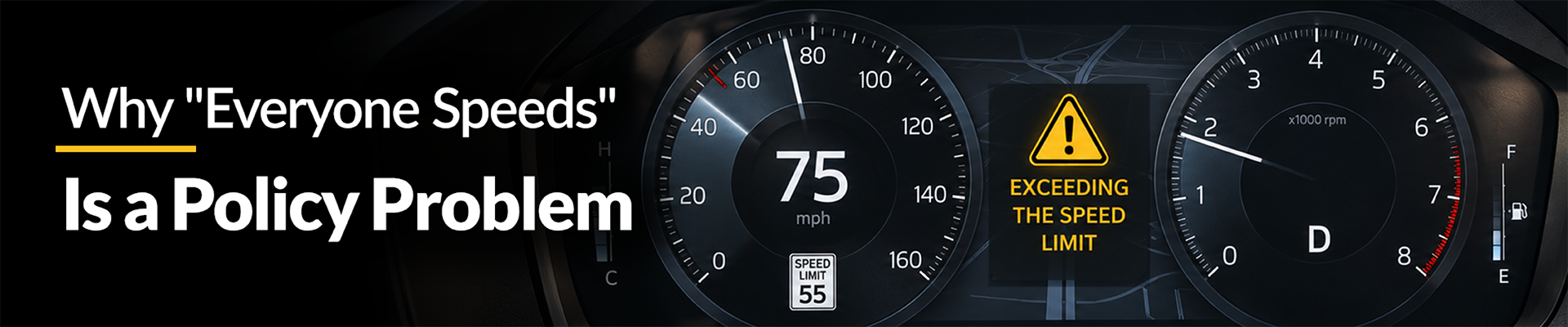
A sales rep merges onto the highway, glances at traffic flowing five miles over the limit, and matches pace without a second thought. A service technician runs behind schedule and nudges the pedal to make up time between stops. Neither driver thinks of this as risky behavior. Both are simply keeping up with the road around them.
That instinct — that speed is set by traffic, not by the posted limit — is more common than most fleet managers might assume. A new study from the AAA Foundation for Traffic Safety found that three in ten drivers agree with the idea that no one follows the posted speed limit, and close to half believe keeping pace with surrounding traffic is safer than sticking to it. Speeding, in other words, has stopped registering as a deliberate choice for a large share of drivers. It has become background behavior.
For fleets, background behavior is the kind of risk that's hardest to manage, because it doesn't show up as a single bad decision. It shows up as a pattern spread across dozens or hundreds of drivers, each one making a small, unremarkable choice that adds up.
The Cost of Normalized Speeding
Speed-related crashes aren't a marginal safety concern. NHTSA data cited in the AAA study shows speeding was a contributing factor in close to 30% of traffic fatalities in 2024. For a fleet operator, that statistic translates directly into claims costs, vehicle downtime, workers' compensation exposure, and — increasingly — liability that reaches beyond the driver to the employer.
What makes the AAA findings useful for fleet managers is the window they open into driver reasoning. Respondents didn't frame speeding as recklessness. The top reasons given were getting around slower traffic, reaching a destination faster, and avoiding holding up the cars behind them. These are the same pressures a fleet driver faces on a daily route: a schedule to keep, a customer waiting, other vehicles setting the pace. Speeding, from the driver's seat, often feels less like a violation and more like a reasonable response to the flow of traffic.
That framing matters for policy design. A safety program built around the assumption that speeding is willful will miss the drivers who see it as situational and justified. The more effective starting point is treating speed as a habit shaped by traffic culture, schedule pressure, and unclear expectations — all of which a written policy can address directly.
Where Written Policy Falls Short
Most fleet safety policies already mention speed limits. Far fewer spell out how the organization defines acceptable margin, how violations are identified, or what happens when a pattern emerges rather than a single incident. That gap leaves room for the same normalization AAA documented among general drivers to take hold inside a fleet.
A speed-specific policy component should answer a few concrete questions:
- What counts as a violation, and does the threshold match how the fleet monitors speed in practice — GPS pings, telematics alerts, or driver self-report?
- How is a one-time lapse distinguished from a recurring pattern, and does the response scale accordingly?
- Who reviews speed data, on what cadence, and what triggers a conversation with the driver?
- Does speed enforcement connect to broader outcomes the fleet already tracks, such as fuel cost, maintenance intervals, and insurance claims?
Answering these questions does two things. It removes ambiguity for drivers who might otherwise assume, like AAA's respondents, that matching traffic is an implicit exception to the limit. And it gives fleet managers a defensible, documented standard if an incident ever draws scrutiny from insurers, regulators, or litigation.
What the AAA Data Suggests About Enforcement Design
One of the more useful parts of the AAA research is what it reveals about driver receptiveness to different countermeasures. Drivers responded far more favorably to approaches that preserve some sense of control — advisory alerts, visible enforcement, awareness campaigns — than to systems that override driver choice outright. Support for speed-limiting technology dropped sharply once the driver lost the ability to override it, even though a majority acknowledged that harder interventions like speed humps are effective.
That distinction is directly relevant to how fleet managers roll out speed monitoring. A policy introduced as a punitive, automated cutoff is likely to generate resistance and workarounds. A policy introduced as visibility plus coaching — telematics data that flags patterns, followed by a conversation rather than an automatic penalty — tends to land closer to what drivers, fleet or otherwise, are willing to accept. Many fleets already have the data infrastructure to support this approach through existing telematics platforms; the missing piece is often a policy that defines how that data gets used and who's accountable for acting on it.
Building the Policy Language
A speed policy doesn't need to be long to be effective, but it does need to move past a single sentence stating that drivers should obey posted limits. Consider structuring it around three components.
Start with the standard. Define the threshold clearly — for example, no more than five miles per hour over the posted limit under normal conditions — and state explicitly that keeping pace with surrounding traffic doesn't override that standard. This directly counters the assumption AAA found to be widespread.
Follow with monitoring and response. Describe how speed is tracked, how often data is reviewed, and what the escalation path looks like: a coaching conversation for a first pattern, additional training for a repeat pattern, and a defined consequence if the pattern continues.
Close with context and conditions. Acknowledge that visibility, weather, and road conditions should lower acceptable speed below the posted limit, not just cap it at the limit. AAA's own guidance to drivers frames the posted limit as a ceiling for ideal conditions, not a target to hit regardless of circumstances — a distinction worth carrying into fleet policy language directly.
Making the Policy Part of Daily Operations
Written policy only changes behavior if drivers encounter it as something more than an onboarding document. A few practical steps help close that gap:
Route planning that accounts for realistic drive times reduces the schedule pressure that AAA identified as a leading reason drivers give for speeding.
Regular, low-stakes reviews of telematics data — monthly rather than only after an incident — normalize the idea that speed is actively monitored, not just theoretically prohibited.
Manager-led conversations about specific trips or patterns carry more weight than blanket reminders sent to the whole fleet.
Recognition for consistent safe-speed performance reinforces the standard without relying solely on penalties for violations.
None of these steps require new technology if a fleet already has telematics in place. They require a policy that says, in specific terms, how that data translates into action.
The Broader Takeaway
The AAA Foundation's research doesn't suggest most drivers are careless. It suggests that speeding has become normalized enough that many drivers no longer experience it as a choice worth reconsidering. For a fleet manager, that's a signal to look at policy language and enforcement design rather than assuming driver character is the variable to fix.
A fleet's speed policy is often one of the least revised parts of a safety program, even as telematics data, insurance requirements, and liability exposure evolve around it. Treating the AAA findings as a prompt to revisit that language — not just to reference it once and move on — is a low-cost way to close a gap that most fleets already have room to address.
Building or refreshing a fleet safety policy is easier with the right data behind it. EMKAY's fleet management and leasing solutions include the telematics integration and reporting tools fleet managers need to turn speed data into a policy that holds up in practice. Learn more about EMKAY's fleet safety solutions.