25 Best AI Tools for Smarter Fleet Workflows

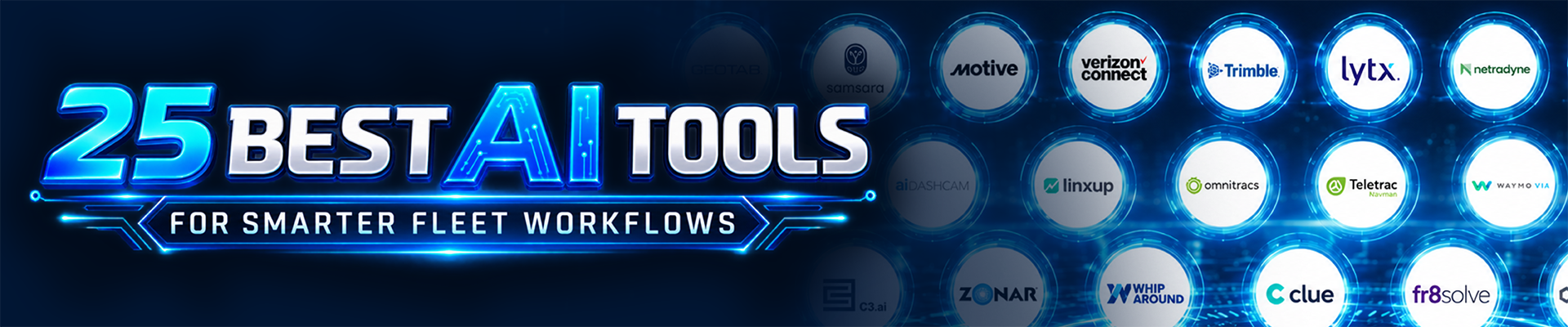
Fleet management has moved well past spreadsheets and static GPS dots on a map. Across telematics, maintenance, and safety, artificial intelligence now does work that used to sit on a coordinator's desk. The result is a fast-growing category of AI fleet management tools, and the field is wide enough that most operations teams have only evaluated a fraction of it.
This roundup organizes 25 of the more established and emerging AI tools for fleet management into six practical groups: comprehensive telematics platforms, driver safety and video, predictive maintenance, route optimization and dispatch, AI-native fleet intelligence platforms, fuel and cost management, and general workflow tools that fleet teams lean on. None of these entries are ranked against each other — fleet size, vehicle mix, and existing tech stack determine fit far more than any single feature list. Use this as a starting point for what automated fleet management now covers, then narrow based on where your own operation feels the most manual.
Comprehensive AI Telematics & Fleet Platforms
These platforms combine GPS tracking, diagnostics, compliance, and AI analytics in one system, functioning as the backbone most fleets build other tools around.
- Geotab Ace takes a more open, customizable approach, with a device network built for fleets that want to shape their own dashboards and data pipelines rather than work inside a fixed interface.
- Samsara built its reputation on AI dash cams trained on a large library of driving footage, paired with a broad telematics suite covering fuel, maintenance, and compliance reporting in one dashboard.
- Enterprise fleets running mixed vehicle types and heavy equipment often land on Verizon Connect, which pairs telematics with the reliability of a large cellular network and detailed usage reporting.
- Motive, formerly KeepTruckin, grew out of ELD compliance and has expanded into AI dash cams and predictive analytics, making it a common mid-market pick for trucking-heavy operations.
- Smaller service fleets frequently choose Azuga, now part of Bridgestone, for its combination of accessible AI monitoring and a driver rewards program that ties safety scores to gamified incentives.
- Power Fleet serves both light-duty and heavy-duty operations with AI-driven asset tracking and maintenance alerts, and integrates readily with third-party dispatch and ERP systems.
AI-Powered Driver Safety & Video
Video-based safety platforms use computer vision to score driving behavior and flag risk in real time, cutting down the hours a safety manager would otherwise spend reviewing footage manually.
- Lytx carries over two decades of driving data into its video safety platform, with machine vision algorithms that remain a benchmark for detecting risky behaviors like following distance and distraction.
- Netradyne analyzes driving footage continuously rather than only after a triggering event, giving fleet managers visibility into everyday habits alongside the incidents that typically get flagged.
- Nauto focuses its AI on distinguishing genuinely dangerous moments from routine driving noise, aiming to reduce the alert fatigue that comes from safety systems that flag too much.
AI Route Optimization & Dispatch
For fleets running high stop counts or tight delivery windows, these platforms rebuild routes dynamically instead of locking in a plan at the start of the day.
- Onfleet manages last-mile delivery with an AI routing engine trained on hundreds of millions of completed deliveries, re-optimizing continuously as new orders, traffic, or driver call-outs shift the day's plan.
- Mid-size fleets often start with Route4Me, which pairs route planning depth with dispatch controls and mid-day re-optimization when stops change after drivers are already on the road.
- OptimoRoute concentrates on constraint-based planning, factoring in time windows, vehicle capacity, and service duration to generate efficient multi-stop sequences for field and delivery fleets.
- Developer-heavy operations tend toward NextBillion.ai, an API-first routing engine built for teams that want to embed fleet intelligence directly into their own logistics software rather than adopt a standalone app.
Knowledge Organization and Search
Top AI tools for knowledge organization span personal note-taking, networked thought mapping, and enterprise-level knowledge bases:
- Tana: A networked note-taking tool that connects ideas dynamically without rigid folder structures, using AI to suggest structure and relationships as you type.
- ClickUp Brain is an AI assistant inside ClickUp that automates support content creation, drafts articles from existing data, and refreshes outdated information.
- If you are looking for an enterprise search and knowledge platform, Glean might be for you. It uses natural language processing to centralize scattered company data, automate tagging, and flag outdated content.
- Notion AI centralizes SOPs, onboarding docs, and internal knowledge in a single workspace, with semantic search and multi-step Custom Agents that can answer a policy question or draft a document without someone digging through old files.
AI-Native Fleet Intelligence Platforms
This newer wave of tools was built AI-first rather than adding machine learning onto an existing telematics product, and several focus on turning insights into automated actions rather than just dashboards.
- Tourmo layers AI across data already collected by a fleet's existing telematics providers, aiming to unify safety, maintenance, and compliance signals without requiring new hardware.
- Ridecell applies AI to fleet operations decisions at scale, with automation tools built for mixed fleets that need to reduce manual dispatch and utilization work.
Fuel & Cost Management AI
- WEX applies AI-driven fraud detection and spend analysis to fleet fuel card programs, flagging anomalous purchases and helping fleet managers control one of their largest variable costs without manually auditing every transaction.
General AI Workflow Tools for Fleet Teams
Not every gap in a fleet operation gets solved by fleet-specific software. Vendor quotes, driver communications, SOP documentation, and cross-system handoffs often run through general-purpose AI tools instead, and several have become common fixtures in fleet coordinators' day-to-day work.
- Airtable functions as a flexible database layer for tracking things no telematics platform covers well, like upfitting quotes or vendor onboarding, with built-in AI that can summarize records, classify incoming data, and generate formulas from a plain-language request.
- Drafting driver notices, building maintenance-cost summaries in Excel, and turning a meeting transcript into a clean recap all fall under Microsoft 365 Copilot, which works across Outlook, Word, and Excel for teams already running on the Microsoft stack.
- Zapier, particularly through its Copilot and Agents features, connects fleet software to the tools that don't talk to it natively — routing a new maintenance alert into Slack, logging a completed inspection into a spreadsheet, or syncing a vendor form submission into a shared database.
- Vendor calls, safety meetings, and driver debriefs get recorded and summarized automatically with Otter.ai, cutting down on the manual note-taking that otherwise falls on whoever ran the meeting.
- For teams inside the Microsoft ecosystem building more structured automations, Power Automate pairs with Copilot to let non-technical staff describe a workflow in plain language and have it built automatically, covering everything from simple approval routing to more involved repetitive back-office tasks.
Choosing where to start
Twenty-five options is a lot to evaluate at once, and most fleets don't need to pilot more than two or three of these. A reasonable starting point is identifying where manual work is heaviest today — safety review, maintenance scheduling, or route planning — and evaluating the two or three tools built specifically for that gap before considering a broader platform swap. Fleets already running a comprehensive telematics system may find that the fastest wins come from a focused predictive maintenance or route optimization tool layered on top, rather than replacing the whole stack.
AI in fleet management is still maturing unevenly across these categories. Predictive maintenance and video safety scoring are the most established use cases with the clearest ROI data behind them; AI-native dispatch and decision-automation tools are newer and worth a structured pilot before a full rollout. Whichever direction fits your operation, the shift underway is consistent: fleet management automation is moving fleet managers away from reviewing every data point manually and toward reviewing the exceptions AI has already flagged as worth their attention.
EMKAY helps fleet managers evaluate and integrate the technology that fits their operations, from telematics to maintenance automation. To talk through what's right for your fleet, contact EMKAY at 630.250.7400 or info@emkay.com.
How to Develop a Successful Predictive Maintenance Program
Predictive maintenance uses vehicle data — mileage patterns, diagnostic trouble codes, sensor readings, engine performance trends — to flag repair needs before a component fails. Instead of servicing a vehicle on a fixed calendar or waiting for a warning light, fleet managers act on signals that point to a specific problem developing in a specific vehicle.
The Most Fuel-Efficient Cars for Fleets That Aren't Hybrids
Hybrids and EVs get a lot of attention when it comes to cutting fleet fuel costs. And sure, they can be a great option — but they're not the only one. Plenty of conventional gas vehicles get great mileage, cost less to buy, and are easier to maintain. No charging infrastructure needed.