Autonomous Fleet Management: Hype vs. Hardware Reality

Every vehicle trade show now includes a booth promising that edge computing will make autonomous driving inevitable within the next few product cycles. Sensor data processes locally; latency drops to milliseconds; the vehicle makes split-second decisions. The pitch is compelling...but the underlying tech has not caught up to it. For fleet managers that see a future with autonomous vehicles, the gap between the actual technology stack and our hopes for it can feel discouraging.
What edge computing is supposed to solve
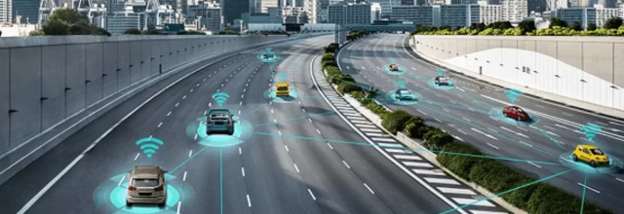
A self-driving system needs to process camera, radar, and lidar feeds in real time, cross-reference them against a live map, and produce a driving decision fast enough to matter at highway speed. Sending that volume of data to a cloud server and waiting for a response introduces delay no safety system can tolerate. Edge computing moves the processing onto the vehicle itself, so decisions happen where the sensors are.
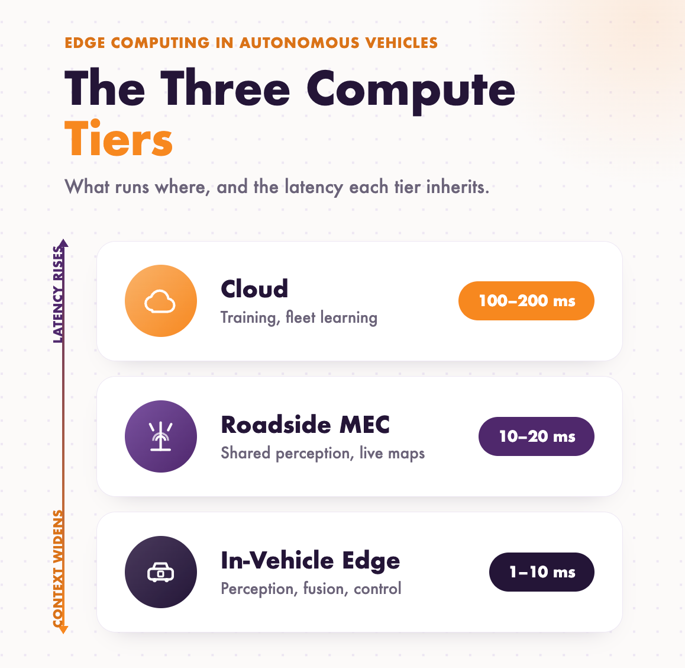
Here are examples for each tier, from the most latency-tolerant to the least.
Cloud (seconds to hours of tolerable delay)
- Training and refining the driving models using data pooled from the whole fleet
- HD map updates and distribution
- Over-the-air software and firmware updates
- Fleet analytics, such as aggregating telematics and ADAS event data for near-miss reporting
- Route planning and traffic prediction across a region
- Remote assistance centers where a human helps a stuck vehicle
Roadside (tens of milliseconds, shared across many vehicles)
- Roadside units at intersections broadcasting traffic signal timing to approaching vehicles
- Work zone and hazard warnings pushed to vehicles ahead of a crash or lane closure
- Intersection cameras and lidar sharing a view of pedestrians or cross traffic that a vehicle’s own sensors cannot see
- Multi-access edge computing servers at 5G cell sites handling local coordination
- Platooning and merge coordination between nearby vehicles
In-vehicle (single-digit milliseconds, no connection required)
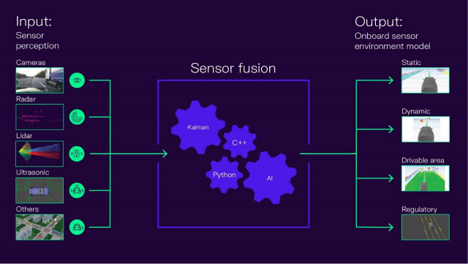
- Sensor fusion that merges camera, radar, and lidar into one picture
- Object detection and classification, covering pedestrians, cyclists, and other vehicles
- Automatic emergency braking and collision avoidance decisions
- Lane keeping and adaptive cruise control
- Driver monitoring for drowsiness and distraction
- Localization and path planning moment to moment
That part of the pitch holds up. The trouble starts with what it costs to do well.
Where the hardware still lags
Sensor fusion (the practice of combining data from multiple local sensors directly on a device's local processor to make instant, accurate decisions without waiting for a distant cloud server) needs a lot of computing power to work reliably in a vehicle. Current in-vehicle processors often struggle to provide that power without using too much electricity or creating too much heat.
Several constraints compound the problem for fleet applications specifically:
- Power draw from edge processors competes with everything else pulling from the vehicle's electrical system, and in electric vehicles where every watt diverted to compute is a watt not going to range, that’s important.
- Thermal management adds cost and complexity that manufacturers are still working through, particularly for vehicles that sit in direct sun during a workday or run extended idle time.
- Connectivity assumptions built into many "AV-ready" systems still lean on periodic cloud updates for mapping and model refinement, which breaks down in the rural or low-coverage service areas where a many light-duty and service fleets operate.
- Cost scales faster than capability. Doubling processing power to handle a marginally more complex driving scenario does not double the price tag — it often multiplies it, because automotive-grade chips carry certification and reliability requirements that consumer electronics do not.
What this means for fleet purchasing decisions
- Treat "autonomy-ready" as a marketing claim to verify, not a spec to take at face value. Ask what the system does today versus what it will eventually support with a future software or hardware upgrade. Those are different products with different budget implications.
- Evaluate ADAS features on their present-day merits. Lane keeping, automatic emergency braking, and adaptive cruise control deliver measurable safety value right now and do not depend on the compute breakthroughs full autonomy requires. Budgeting for those capabilities makes sense independent of where the broader AV market lands.
- Factor connectivity gaps into any evaluation. A system that depends on frequent cloud synchronization will perform differently across a fleet that spans dense metro routes and rural service territory.
The fleets that benefit most from this moment are the ones separating the compute story from the safety story. Edge computing will keep improving, and the hardware will eventually close the gap with the marketing. Until it does, the sound purchasing decision is the one grounded in what a vehicle can verifiably do today.
What autonomous fleet management looks like before full autonomy arrives
Autonomous vehicle fleet management, for the vehicles on the road today, mostly means managing a fleet of ADAS-equipped vehicles. Driver training should cover what the ADAS suite does and does not handle, so operators treat lane keeping and automatic braking as a safety layer rather than a substitute for attention. Data from these systems, when a fleet management platform is set up to capture it, gives operations leaders an early read on near-miss patterns before they become claims.
Insurance and liability conversations are shifting too, as carriers start asking fleets what driver-assist technology is installed and how it is maintained. Getting ahead of that documentation now positions a fleet well regardless of how quickly the underlying hardware matures.
EMKAY helps fleet managers evaluate vehicle technology decisions against real operational needs. Reach our team at 630.250.7400 or info@emkay.com.