Company Car vs. Car Allowance: What It Actually Costs

A car allowance can look like the easy answer. Pay drivers a flat amount each month. No vehicles to buy. No fleet to manage. Then the payroll taxes hit. The allowance stops covering the miles. And the company has no say in what its people drive.
This is the real cost-benefit picture: what an allowance costs, what a company car costs, and when each one makes sense.
Car allowance vs. company car: how each works
A car allowance is a fixed monthly payment to employees who drive their own vehicle for work. You'll also see it called an auto allowance, a car stipend, or an employee automobile allowance. It's all the same thing: a flat amount added to a paycheck. The employee picks the car, pays for it, insures it, and maintains it.
A company car is a vehicle the business provides. In a fleet program, the company leases or owns the vehicles, and a fleet partner handles acquisition, maintenance, fuel, registration, and resale. The employee drives. The company controls the rest.
| Car allowance | Company car (fleet program) | |
|---|---|---|
| Who owns the vehicle | Employee | Company or lessor |
| Monthly cost to company | Fixed allowance + payroll taxes | Lease, fuel, maintenance, insurance |
| Taxable to employee | Yes, as wages | Personal use only |
| Tied to miles driven | No | Yes |
| Company control over vehicle | None | Full |
| Admin burden | Low | Low with a fleet partner |
Is a car allowance taxable?
Yes. A flat car allowance is taxed as regular wages. The IRS treats it as income because the employee doesn't have to account for how it's spent.
That means two tax bills on every dollar:
- The employee pays federal income tax, state income tax, and their share of Social Security and Medicare.
- The company pays its 7.65% share of Social Security and Medicare on top of the allowance.
The result: the company spends more than the allowance, and the employee keeps less. Depending on tax bracket, a third or more of every allowance dollar never reaches the car.
Company cars are taxed differently. Business use isn't taxable to the employee. Only personal use, like commuting or weekend driving, counts as a taxable fringe benefit, and the IRS gives employers set methods to value it.
There is a tax-free way to reimburse employees who drive their own cars: an accountable plan, such as cents-per-mile reimbursement or a FAVR program. Those require mileage tracking and substantiation. We break down that comparison in IRS Mileage Reimbursement vs. a Fleet Program.
The cost comparison: one driver, one year
A $700 monthly allowance costs the company about $9,043 a year. The employee keeps about $5,494 of it. That's 61 cents of car for every dollar spent.
Here's the math for an Illinois employee in the 22% federal bracket. The $700 figure is close to the U.S. average monthly allowance reported by Cardata.
| Car allowance, per year | Amount |
|---|---|
| Allowance ($700 × 12) | $8,400 |
| Employer Social Security + Medicare (7.65%) | $643 |
| Total cost to company | $9,043 |
| Employee federal income tax (22%) | –$1,848 |
| Employee Social Security + Medicare (7.65%) | –$643 |
| Employee Illinois income tax (4.95%) | –$416 |
| What the employee has for the car | $5,494 |
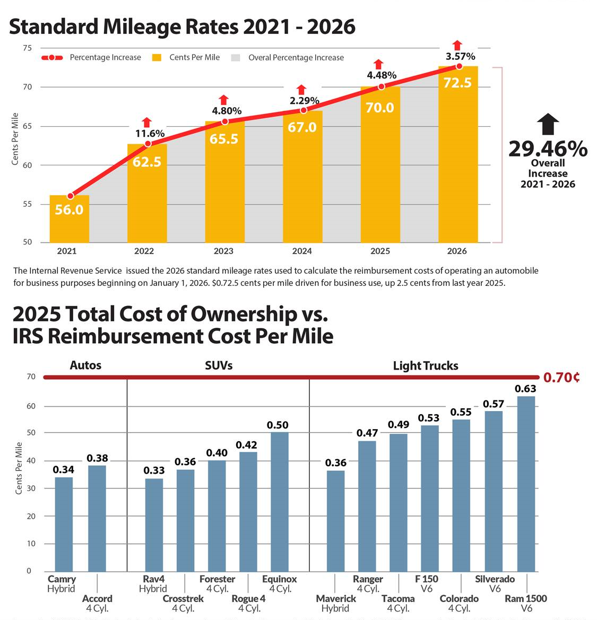
Now add the miles. The IRS business mileage rate is 76 cents per mile as of July 1, 2026. That rate reflects the full cost of running a vehicle: fuel, depreciation, insurance, and maintenance. A driver covering 15,000 business miles a year runs up about $11,400 in vehicle costs. Their $5,494 doesn't come close.
With a company car, every dollar goes to the vehicle. And the company buys at fleet pricing, maintains on a schedule, and resells at the right time.
The costs that don't show up on payroll
The tax hit is the visible cost. These are the ones that surface later.
- Safety. With an allowance, you don't choose the car. An employee can drive a 12-year-old vehicle with bald tires on company business. You have no say in safety ratings, recalls, or maintenance.
- Liability. When an employee crashes on the job, the company can still be on the hook. Their personal policy may carry minimums far below what your risk team would accept.
- Reliability. A breakdown means a missed appointment, and a fix on the employee's schedule, not yours.
- Fairness. A flat allowance pays the same whether someone drives 300 miles a month or 3,000. Low-mileage drivers are overpaid. High-mileage drivers are underpaid, and they tend to be your best salespeople and technicians.
- Brand. The car represents your company. With an allowance, it's whatever the employee bought.
- Recruiting. A company car is a tangible benefit. For field roles, it's a real reason to say yes.

When a car allowance makes sense
An allowance isn't always wrong. It can fit when:
- Employees drive fewer than 5,000 business miles a year.
- Driving is occasional, not core to the job.
- You have only a handful of drivers, spread out, with no need for a consistent vehicle.
- The car is a perk for an executive, not a working tool.
Once driving is part of the job, the math tips toward a fleet. High miles, many drivers, and customer-facing roles all point the same way.
How to decide: five questions
- How many business miles does each driver cover per year?
- What are you spending on allowances today, including your share of payroll taxes?
- Do you know what your employees are driving, and whether it's safe?
- What happens to your business when a driver's car breaks down?
- Would a company vehicle help you hire or keep people in field roles?
If the answers point to high miles, real risk, or rising allowance costs, it's time to run the numbers on a fleet.
See your numbers
EMKAY has helped companies run their fleets since 1946. We'll compare what your car allowance program costs today against a fleet built for your drivers, your miles, and your business. Talk to an EMKAY fleet expert!
FAQ
How much is a typical car allowance per month? In the U.S., the average car allowance is about $700 per month. Cardata reported averages rising from $651 in January 2025 to $706 by September 2025. Remember that taxes reduce what the employee actually keeps.
Is a car allowance taxable? Yes. A flat car allowance is taxed as wages. The employee pays income and payroll taxes, and the employer pays its share of Social Security and Medicare.
What's the difference between a car allowance and a car stipend? None. Car stipend, auto allowance, and employee automobile allowance all describe a fixed payment for using a personal vehicle for work.
Is a company car better than a car allowance? For employees who drive often for work, usually yes. A company car avoids the payroll tax loss, gives you control over safety and liability, and ties cost to the vehicle instead of a flat number set years ago.
Can you offer both? Yes. Many companies give company cars to high-mileage field roles and an allowance or mileage reimbursement to occasional drivers.
Autonomous Fleet Management: Hype vs. Hardware Reality
Every vehicle trade show now includes a booth promising that edge computing will make autonomous driving inevitable within the next few product cycles. Sensor data processes locally; latency drops to milliseconds; the vehicle makes split-second decisions. The pitch is compelling...but the underlying tech has not caught up to it. For fleet managers that see a future with autonomous vehicles, the gap between the actual technology stack and our hopes for it can feel discouraging.
What Is Fleet Management? Services, Costs, and What to Expect
Some businesses don't set out to build a fleet. They add a vehicle to solve a problem, then another, then a few more — and at some point the informal systems holding everything together start to crack. Spreadsheets can't track maintenance intervals across thirty vehicles. A single office manager can't field driver calls, coordinate repairs, and keep fuel receipts organized at the same time. Compliance deadlines get missed. Costs climb without explanation.