Closed-End vs. Open-End Leases: Which Fits Your Fleet?

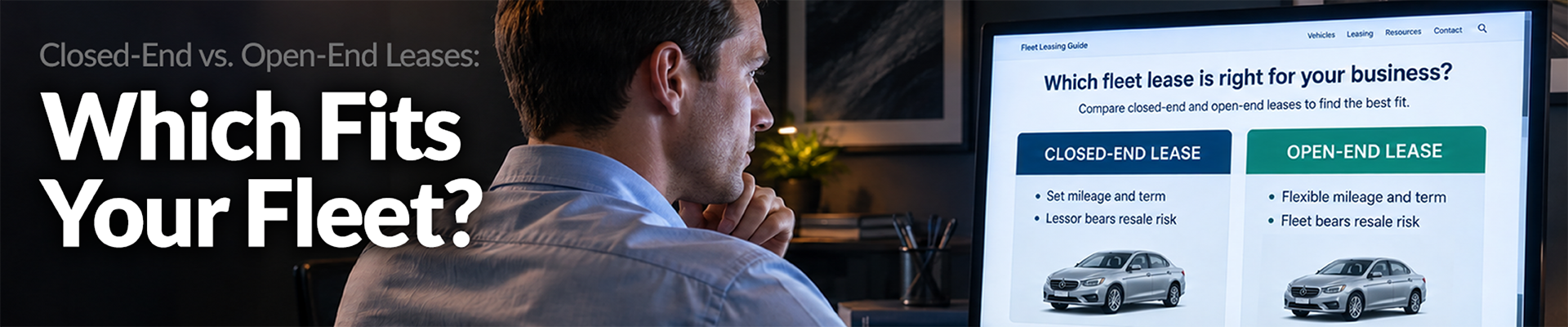
Closed-end and open-end leases assign that residual value risk to different parties. That single difference shapes your mileage freedom, your exposure at turn-in, how flexibly you can replace vehicles, and how predictable your fleet budget will be. This guide covers how each one works, where each tends to fit, and the questions to settle before committing vehicles to either.
The Short Answer
- Closed-end lease: The leasing company carries the residual value risk. You return the vehicle at the end of the term and pay only for mileage over the allowance and damage beyond normal wear.
- Open-end lease: Your organization carries the residual value risk. At term end the vehicle is sold, and you receive any amount above its remaining book value or pay any shortfall.
As a general pattern, open-end leases are the standard structure for corporate and commercial fleets. Closed-end leases suit low-mileage, lightly used vehicles where a fixed cost matters most.
How a Closed-End Lease Works
A closed-end lease sets a fixed term, a fixed monthly payment, and a mileage allowance at signing. The leasing company projects what the vehicle will be worth at the end of the term (its residual value) and builds the payment around the expected depreciation, plus interest and fees.
At lease end, you return the vehicle. If its market value comes in below the projection, the leasing company absorbs the loss, which is why closed-end leases are often called "walk-away" leases.
Walking away still comes with conditions. Expect charges for:
- Miles driven beyond the contracted allowance, billed at a per-mile rate
- Damage that exceeds the lessor’s definition of normal wear and tear
- Early termination, which can be expensive when a vehicle has to leave service before the term ends
Where closed-end leases work well
- Vehicles with predictable, moderate annual mileage
- Units with little or no upfitting
- Fixed replacement schedules where each vehicle stays in service for the full term
- Organizations that place a premium on a fixed monthly cost and limited end-of-term exposure
Where they create friction
- High or unpredictable mileage leads to overage charges
- Upfitted vehicles can trigger wear and damage disputes at turn-in, and equipment removal adds cost
- Rigid terms make early rotation difficult when a vehicle’s role changes
- The lessor prices residual risk into the payment, so that protection is built into your cost whether or not you need it
How an Open-End Lease Works
An open-end lease has no mileage cap and typically no excess-wear penalties at turn-in. The vehicle depreciates on a schedule set in the contract, and its book value declines each month as payments are made. Most open-end agreements carry a minimum term, commonly 12 months, after which the lease can continue month to month until you choose to replace the vehicle.
When the vehicle comes out of service, it is sold, usually at auction or through another remarketing channel. The sale price is then measured against the remaining book value:
- Proceeds above book value come back to your organization as a credit.
- Any shortfall below book value is billed to your organization.
This end-of-term settlement is the central trade. You accept residual risk, and in return you gain control over mileage, timing, and how hard each vehicle works. Well-maintained vehicles sold at the right point in their lifecycle often return equity. Units kept too long, driven hard, or sold into a soft used-vehicle market can come back with a balance due.
TRAC leases
Commercial open-end vehicle leases in the U.S. are commonly structured as TRAC leases, named for the Terminal Rental Adjustment Clause that governs the end-of-term adjustment. Under federal tax rules, a TRAC clause does not prevent a vehicle lease from being treated as a true lease, provided the vehicle is used more than 50 percent for business. That treatment is a large reason open-end TRAC leasing became the norm for commercial fleets. Confirm with your tax advisor how it applies to your organization.
Where open-end leases work well
- High-mileage or variable-mileage operations
- Upfitted service vans and work trucks in heavy daily use
- Fleets that time replacements around total cost of ownership and resale conditions
- Organizations with the data and discipline to manage maintenance and remarketing actively
Where they carry more risk
- Final cost stays unknown until the vehicle is sold, which makes budgeting less predictable
- Swings in the used-vehicle market land on your organization
- Deferred maintenance and extended holding periods cut directly into resale value
- Accounting treatment can be more involved, depending on how the lease is classified
Side-by-Side Comparison
| Factor | Closed-End Lease | Open-End Lease |
|---|---|---|
| Residual value risk | Leasing company | Your organization |
| Mileage limits | Annual or total allowance; overage fees apply | None |
| Wear and tear | Assessed at turn-in | Included in resale value |
| Excess-wear charges | At turn-in | Reflected in resale value |
| Term | Fixed, typically 24 to 48 months | Minimum term, then month to month |
| Early termination | Often costly | Generally flexible after the minimum term |
| End-of-term outcome | Return vehicle, pay any fees | Vehicle sold; gain credited or loss billed |
| Upfitting | Can complicate turn-in | Well suited |
| Budget predictability | High | Moderate |
| Potential for equity | None | Possible when resale beats book value |
| Common use | Low-mileage, lightly used vehicles | Most corporate and commercial fleets |
How to Choose: Five Deciding Factors
1. Mileage patterns
Pull annual mileage by vehicle or by role, since a fleet-wide average can hide the units most likely to exceed an allowance. Closed-end leases lock the allowance in at signing, and routes or territories that shift during the term can push vehicles past their limits. When mileage data is spotty or varies widely, open-end is the safer structure.
2. Duty cycle and upfitting
Vehicles that carry tools, equipment, or custom upfits take on wear that a closed-end lessor will inspect closely at turn-in. Cargo-area damage, mounting holes, and job-site exterior wear all count. Open-end leases fold that wear into the resale price, so it shows up as part of the vehicle’s market value in the final settlement.
3. Replacement timing
Closed-end terms set the replacement date in advance. Open-end leases let you replace vehicles when the numbers favor it: before a major maintenance milestone, ahead of a model changeover, or while used-vehicle prices are strong. Fleets that actively manage lifecycle cost tend to get the most value from that flexibility.
4. Budget predictability vs. total cost
Finance teams often favor closed-end leases because the monthly cost is fixed and end-of-term exposure is limited to mileage and damage. Open-end leases can lower total cost over time, since there is no margin paid for the lessor to carry residual risk and resale gains return to you. The deciding question is which your organization weighs more heavily: certainty in the monthly line item, or the lowest cost across each vehicle’s life.
5. Accounting and tax treatment
Under ASC 842, most leases longer than 12 months appear on the balance sheet regardless of structure, though operating or finance classification can vary with contract terms. TRAC provisions carry their own tax considerations as well. Bring your controller or accounting team in early so lease structure does not create reporting surprises later.
Matching Lease Type to Vehicle Role
Many fleets assign lease structure by vehicle role instead of choosing one approach for every unit. The table below shows common starting points.
| Vehicle role | Typical fit | Why |
|---|---|---|
| Sales and territory sedans or SUVs | Open-end | High annual mileage and frequent territory changes |
| Upfitted service vans | Open-end | Heavy use, installed equipment, flexible replacement timing |
| Pickups and work trucks | Open-end | Job-site wear and variable duty cycles |
| Executive and low-use pool vehicles | Closed-end often fits | Low mileage, light use, predictable term |
| Seasonal or specialty units | Either | Depends on mileage certainty and planned holding period |
| Electric vehicles | Case by case | Closed-end shifts uncertain resale values to the lessor; open-end lets you capture upside if EV resale strengthens |
Questions to Ask Before You Sign
- How is the depreciation schedule or residual value set, and can it be adjusted for upfitted vehicles?
- Under a closed-end agreement, what per-mile rate applies to overage, and is mileage measured annually or across the full term?
- Is there a written excess-wear standard you can review before signing?
- On an open-end lease, how long is the minimum term before month-to-month flexibility begins?
- Which remarketing channels are used at term end, and what reporting will you receive on sale results?
- If a vehicle needs to leave service early, what are the termination terms under each structure?
- Will either structure change how the lease is classified for accounting?
Frequently Asked Questions
1. What is a closed-end lease?
A closed-end lease is a fixed-term vehicle lease in which the leasing company assumes the risk that the vehicle will be worth less than projected at term end. The lessee returns the vehicle and pays only for excess mileage, excess wear, or other fees defined in the contract.
2. How does an open-end lease work?
In an open-end lease, the lessee assumes residual value risk. At the end of the term, the vehicle is sold, and the lessee either receives the surplus above book value or pays the shortfall.
3. Is an open-end lease the same as a TRAC lease?
A TRAC lease is a type of open-end lease used for commercial vehicles. Its Terminal Rental Adjustment Clause defines the end-of-term adjustment and allows the arrangement to be treated as a true lease for tax purposes when the vehicle is used more than 50 percent for business.
4. Which lease type costs less?
Neither is cheaper by default. Closed-end payments include a margin for the residual risk the lessor carries. Open-end leases return resale gains to you and also expose you to losses. Over a full lifecycle, actively managed open-end fleets often come out ahead, while closed-end leases deliver more cost certainty.
5. Can a fleet use both lease types?
Yes. Many fleets use open-end leases for high-mileage and upfitted units and closed-end leases for low-mileage vehicles where a fixed cost matters most.
Finding the Right Structure for Your Fleet
Lease structure shapes your monthly costs, your end-of-term exposure, and how freely you can manage vehicles in the field. The right answer usually comes from your own data: mileage by role, upfit requirements, replacement goals, and how your finance team weighs predictability against total cost.
EMKAY’s fleet consultants help organizations evaluate lease options vehicle by vehicle and build a strategy around how each unit is used. Call 630.250.7400 or email info@emkay.com to talk through your fleet.
Fleet Management Trends for 2027: What AI Means for Fleet Operations
The fleet management trends worth watching in 2027 center on readiness. Can your data, your processes, and your vendors support software that acts without a person driving every step? Below are six shifts from Isenberg's list, translated for fleet managers and for the operations, HR, finance, and procurement leaders who share responsibility for company vehicles.
How to Choose the Right Trucks for Construction Fleets
Picking the wrong truck for a construction fleet typically shows up gradually — in maintenance costs that creep up, in drivers pushing vehicles past their rated capacity, in uptime numbers that never quite hit target.